


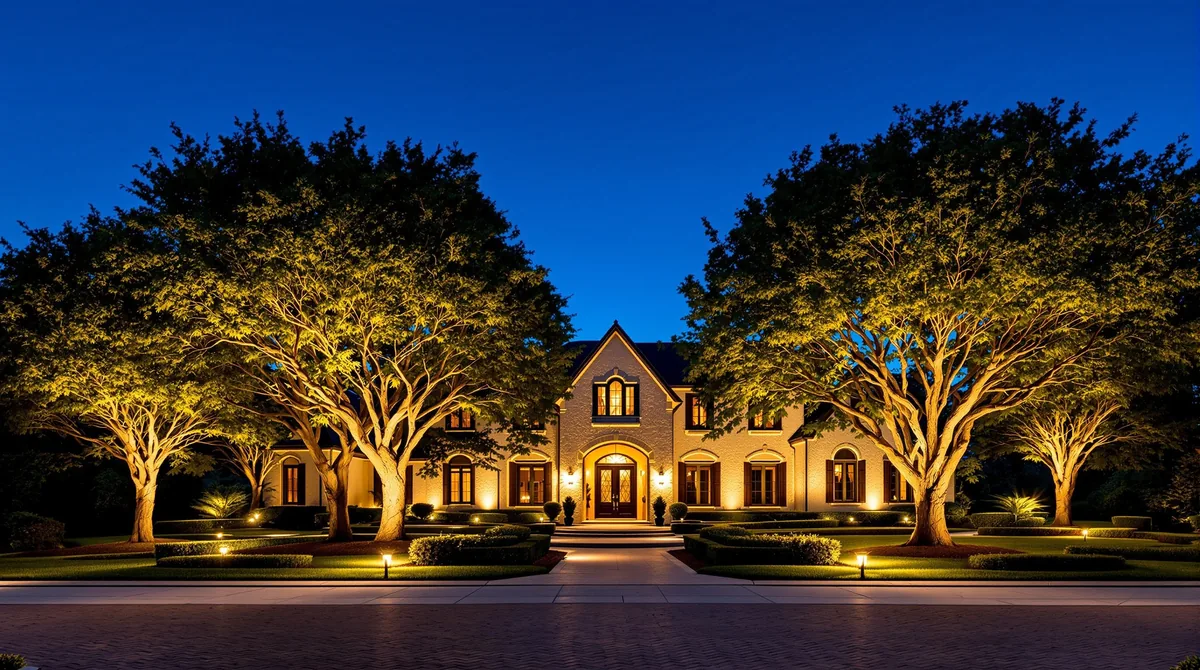

A landscape lighting system on a high-end home is not finished on installation day and then forgotten. Trees grow, a storm moves a branch across a beam, a lens films over, and a fixture that was perfect in April can be pointing at nothing by August. Caring for the system is part of owning it. The design should have assumed that from the start.
This is the long life of landscape lighting in Nashville after the night it was first aimed: the house, the planting, and the outdoor rooms, kept in the balance you approved. Outdoor lighting in Nashville at Light TN is built to be tended, which is a different promise from a box of fixtures that were never meant to be opened again.
Nothing here is a claim that a lifetime warranty means a lifetime of no attention. The studio’s own pages say the opposite. There is no single service life for every lamp, fixture, and control. Lifetime coverage is not a prediction that a growing garden will never cross a beam.
01What changes through the year
Light TN’s homepage describes lighting built to perform beautifully season after season, and its Belle Meade page summarizes the review notes the same way: the lighting holds up. The year still changes the picture. Growth crosses beams that were clear when they were aimed. A canopy fills in, and a moonlighting effect that was open becomes a denser dapple or disappears into leaves. Limbs drop. A planting bed can grow across a path light.
The published maintenance issues are ordinary and specific. Dirty lenses. Fixtures that have shifted. Plant growth across a beam. Worn gaskets that no longer keep water and dust out. Damaged connections. Light TN’s landscape pages, citing the same categories fixture makers publish, say a growing landscape can require repositioning and re-aiming. The design is expected to anticipate that trees and beds change. A system drawn only for the day it was installed will look accidental a few seasons later.
02After a storm
Middle Tennessee storms are part of owning anything outdoors. The studio does not publish a separate storm program or a promised response time, and this page will not invent one. What it can say is which failures are worth noticing after wind and rain, because they are the same failures the site already names. A fixture knocked off its aim. A limb lying through a beam. A connection opened or a cable disturbed where other work, or the weather, has been. Moisture in a housing when a gasket has given up.
Before you ask for a visit, note what you are seeing. Is one light out, one run, or the whole system? Did it start after the storm, or has that bed been dark for weeks? A photograph and the location, taken in the dark if you can do it safely, tell a technician more than “the lights are wrong.” Electrical testing and connection work belong to someone qualified. Low voltage does not make a cut or a soaked connection a homeowner repair. Do not open equipment while you are standing in water.
…Daryll answered the call to a system not working 2 days before the July 4th weekend. He first sent over a few trouble shooting instructions, but it was not successful. So, he was out the next morning, and found a faulty repeater unit and replaced it.— Brian C., Google review
That account is one homeowner’s repair before a holiday, not a published promise of next-day service. Light TN’s installation page says an existing system is assessed before replacement is recommended. That is the right order after a storm, too.
03Growing trees and re-aiming
The tree guide on this site is explicit. A canopy fills in, limbs drop, and a crown widens over years, so aiming and beam choice should account for where the tree is headed. A tree lit only for today gets swallowed. Fixtures mounted in a canopy use hardware that allows growth without harming the tree. None of that removes the need to look again. Re-aiming is the adjustment that keeps an uplight on the trunk and a downlight in the limbs as the tree becomes a larger version of itself.
The same is true at ground level. A path light swallowed by a hydrangea is not a failed LED. It is a plant doing what it was planted to do. Kichler’s maintenance guidance, which Light TN’s pages cite, calls for checking the lighting as the landscape changes, including repositioning and re-aiming. On a property with mature trees, that check includes the view from the house, not only the view from the lawn. A beam that is charming in the garden can glare in a bedroom window once the leaves thin. The tree lighting guide is the design side of this. The care side is a willingness to aim again.
Daryl installed our landscape lights several years ago and continues to do routine maintenance as needed. He is quick to respond, shows up on time and is fair.— Mary Jo M., Google review
04How long the light is built to last
The equipment is chosen for a long outdoor life, and the published numbers are specific. Solid brass and copper fixtures, which patina rather than corrode. Low-voltage LED. Manufacturer lifetime warranties on the fixtures. An annual fixture failure rate under 1%. A one-year workmanship warranty on the installation. The LED lighting notes add the useful limit on the lamp itself: the studio specifies fixtures rated for tens of thousands of hours, and many manufacturers rate 50,000 hours or more. The U.S. Department of Energy’s explanation, cited on that page, treats useful LED life as the point when output has fallen to about 70 percent. Drivers and other electronics can fail on their own. An hours rating is not a guarantee for the whole system.
Color is part of longevity, too, in the sense that you will want to keep it. Light TN designs at 2700K, a warm white, with high-CRI diodes so brick, stone, and leaves still look like themselves. A cheap cool diode can meet a life rating and still make a facade look gray. The metal and the diode are why the system can be tended for years instead of replaced. They are not a reason to skip the lens, the aim, or the gasket.
05Warranty, and a service visit
These are different things, and the published terms keep them separate. Light TN states a one-year workmanship and performance warranty on installation, lifetime manufacturer fixture warranties as each manufacturer provides them, and a satisfaction guarantee as described in the project agreement. The FAQ on the studio’s site puts the guarantee in plainer language: if you are not happy with the outcome, you don’t pay. The written contract controls if it conflicts with the website. A product warranty does not automatically include the labor of a visit years later, and it does not cover a shrub that grew into the beam.
Ask, when you are comparing proposals, what an adjustment costs and what a failure costs. The proposal guide on this site says not to infer a free annual plan or a guaranteed response time from a warranty paragraph. Light TN does publish maintenance plans for commercial properties, with the scope agreed around that property. A residence is a conversation about the system you have, not an assumption that a commercial schedule applies. Record whether one fixture, one run, or the whole system is affected, and whether you are asking for a repair, a re-aim, or a redesign.
06A system meant to be opened again
The landscape lighting service describes the build: low-voltage LED, brass and copper, concealed runs, trenchless burial on an established lawn, and a return after dark to aim. Buried cable should stay documented, because later planting and other work can meet a wire no one can see. “Out of sight” is not “safe to forget.” Transformers are sized with headroom so a later fixture is not a new electrical project by surprise. Those choices are how a system stays serviceable.
Related reading: lighting ideas by house style, lighting a traditional or historic house, what the design walkthrough includes, and lighting an evening at home.
If something has shifted, grown over, or gone dark, contact the studio and describe the location and when it changed. If you are planning the system and want it to age with the trees rather than against them, the consultation is the right start. Daryl walks the property, the rendering shows the intended night, and the aiming visit sets the first balance.